
ARC PRISM
Raw video in.
Learning signals out.
Turn raw video into structured understanding: segmentation, tracks, motion, language, 3D maps, floor plans, and object locations. One modular analysis layer for robot learning and spatial intelligence.
AUTONA ROBOT CLOUD / VIDEO INTELLIGENCE
- START WITH
- Raw video and available camera context
- WORK TOWARD
- Analysis videos, annotations, spatial maps
- BUILT FOR
- Robot data, learning, and deployment teams
See the source. Inspect the signals.
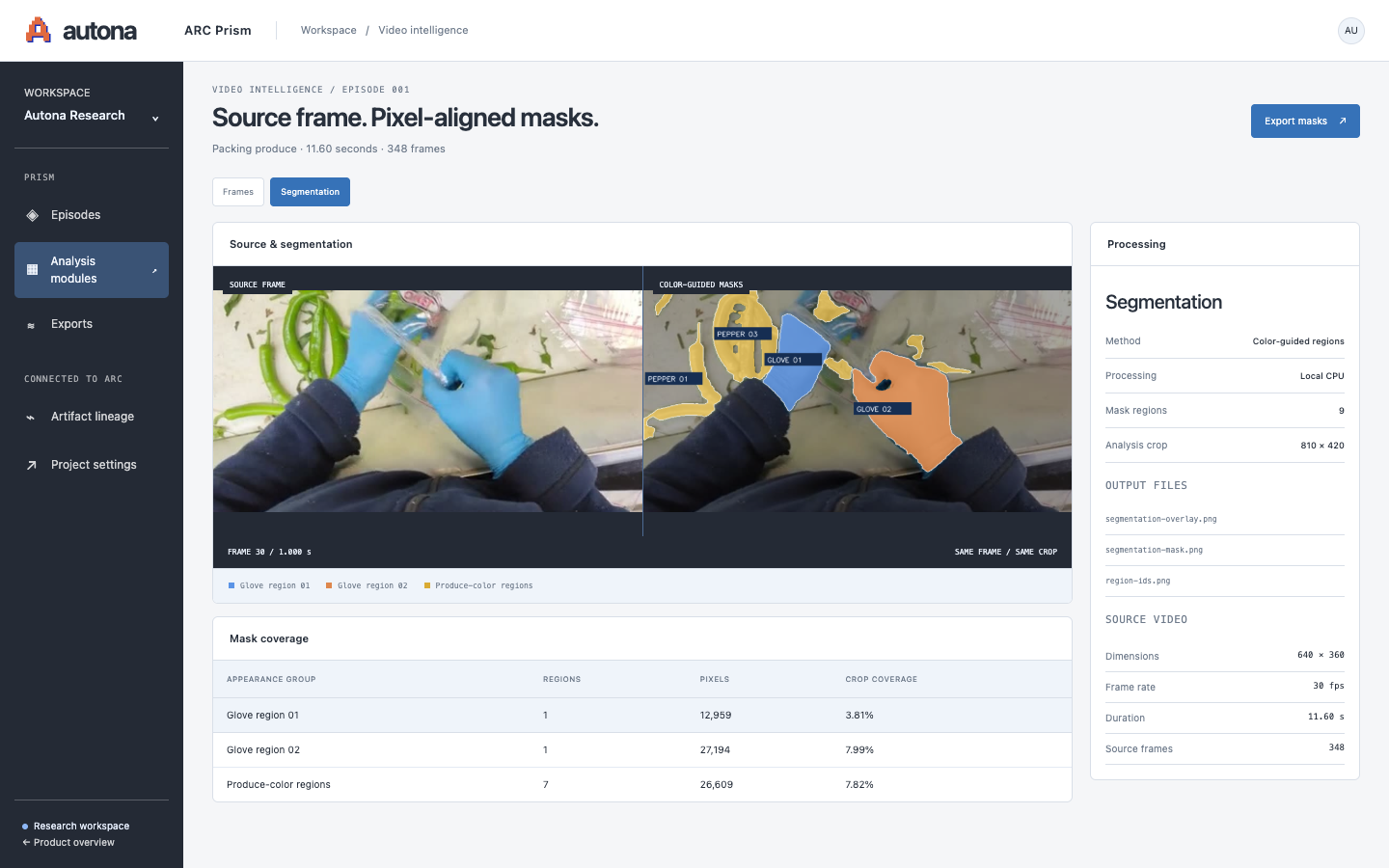
Inspect frames decoded from the source video and color-guided masks computed from the same recording.
Start with
the question.
What matters in your footage? Combine the processing layers that help your robot understand the scene, the action, and the space around it.
Every signal stays tied
to the source.
Visual context
Read the scene.
- Frame extraction
Timestamped frames and capture metadata
View frames- Segmentation
Mask sequences, overlays, label metadata
View segmentation- Object & feature tracking
Tracks, trajectories, overlay videos
Motion & meaning
Follow the action.
- Optical flow
Flow fields, motion videos, summaries
- Camera motion
Motion estimates and fit diagnostics
- Language annotations
Timed language, overlays, review status
Spatial context
Understand the space.
- Video-to-3D mapping
3D scene maps and reconstruction evidence
- 2D floor planning
2D layouts, boundaries, occupancy layers
- Object localization
Map-linked object locations and confidence
One recording.
Multiple layers of understanding.
Raw pixels are only the starting point. Prism is designed to extract the signals, temporal meaning, and spatial context that connect a recording to a useful robotics workflow.
Feed in raw footage
Import an egocentric recording or environment walkthrough, along with available camera and capture context.
Choose the analysis layers
Connect perception, motion, language, and spatial modules around the outputs your task requires.
Carry understanding forward
Send annotated data toward Datarig and learning workflows, or pass reconstructed spatial assets to Synth and deployment planning.
Turn your footage into training data.
Tell us about your robot, your team, and the problem you want to solve.