
ARC PRISM / SEG
See the regions.
Understand the scene.
Transform footage into per-pixel region maps and synchronized overlay videos. Separate the visual scene into masks that other learning and analysis workflows can use.
VISUAL PERCEPTION
- START WITH
- Video frames and a segmentation method
- WORK TOWARD
- Mask sequences, overlays, label metadata
- CONNECTED TO
- Object analysis, spatial mapping, datasets
Inside segmentation.
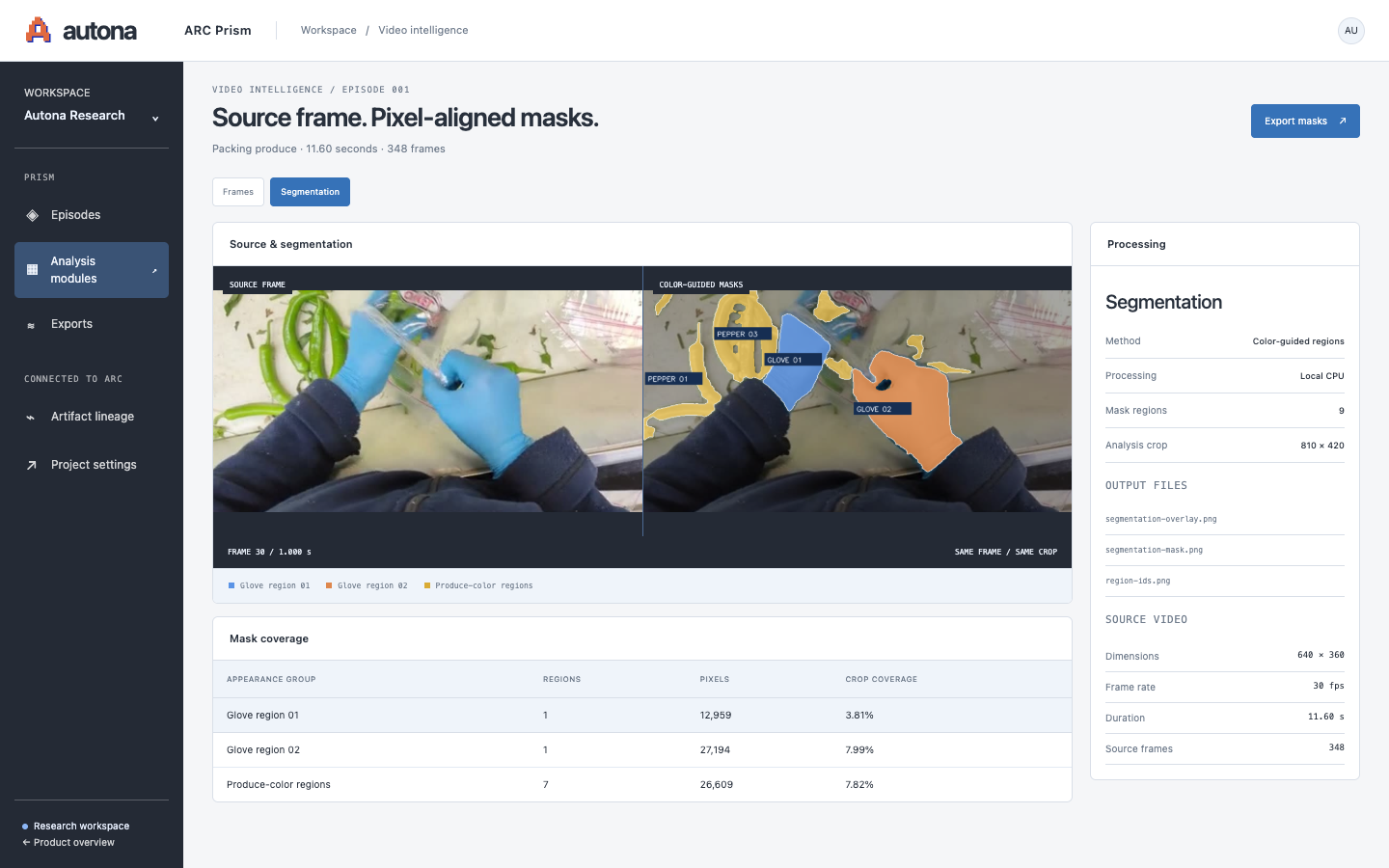
Compare a source frame with its pixel-aligned, color-guided masks.
More structure
in every frame.
A video shows the scene. A segmentation layer makes its regions explicit, creating a visual and machine-readable representation that can be inspected alongside the original.
Choose the method
Define the segmentation approach and the region or class vocabulary appropriate to the footage.
Process the sequence
Generate per-frame masks, then inspect coverage, boundaries, and consistency across time.
Use the region layer
Pass masks and provenance into object localization, dataset preparation, or other analysis.
Appearance regions, semantic classes, and individual object instances are different outputs. The selected method and label vocabulary stay explicit in each result.
Turn pixels into usable regions.
Tell us about the footage, environment, and outputs your team needs.