Define observations and actions.
Workspace and wrist views, joint state, gripper state, and nut-to-stud alignment define the learning problem. The robot contract maps actions to the two arms.
 autona ROBOTICS
ARC ENVIRONMENTS
Task-specific simulation environments for robot reinforcement learning. Define the robot, scene, observations, actions, rewards, resets, and success criteria in a versioned environment that training teams can reuse.
AUTONA ROBOT CLOUD / ROBOT RL ENVIRONMENTS
YAM pipe-flange fastening with scene context, observation/action contracts, rewards, resets, and held-out evaluation. Interface settings are illustrative; the scene is an authored simulation example.
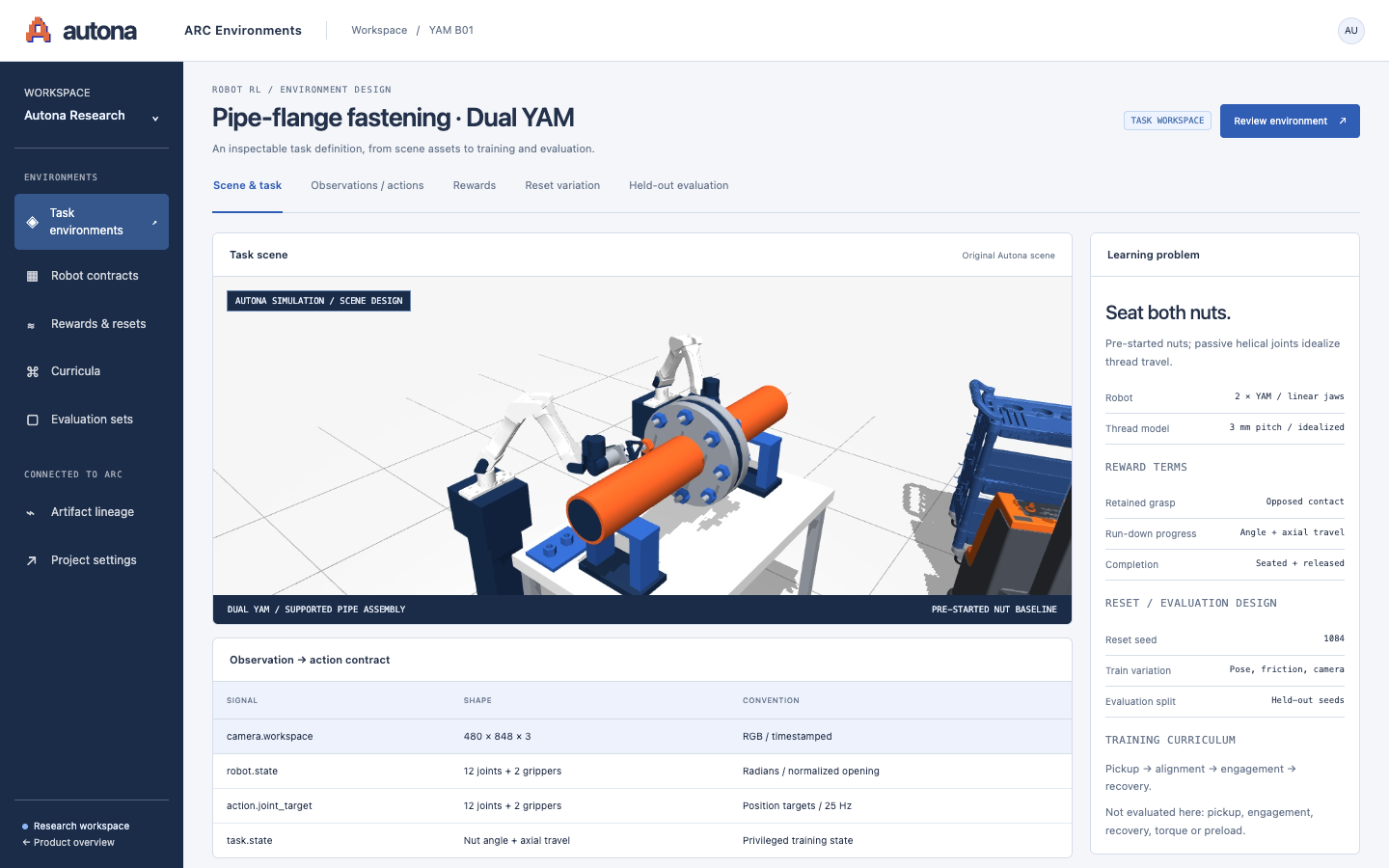
A supported pipe assembly, paired flanges, and two nuts already engaged on their studs. The recorded simulation covers grasp, turn, release, and regrasp.
Workspace and wrist views, joint state, gripper state, and nut-to-stud alignment define the learning problem. The robot contract maps actions to the two arms.
Track retained contact, engaged turns, axial travel, seating, and release. Build training variation around part poses, friction, and recovery cases.
Replay each turn, seating, and final withdrawal. Compare the recorded motion with the task’s completion criteria.
Robot learning needs environments with useful observations, responsive physics, and measurable completion criteria. Connect a task reference to the scene, robot contract, rewards, and resets that define the training problem.
Start with the desired behavior, a video or scene description, a robot embodiment, and measurable completion criteria.
Model objects, fixtures, contacts, and control interfaces. Review scripted baselines and disclose idealized mechanics before using the environment for training.
Use a reproducible reset/step interface, track reward terms, and evaluate learned policies on held-out layouts and recovery cases.
Tell us about your robot, your team, and the problem you want to solve.